

I did a presentation at SuiteWorld in 2017 as a customer of NetSuite. That is when I realized that I could be better served helping other small companies from the eyes of a consultant. Below is a what a delivered as part of my presentation and it still rings true today.
Identifying your problem areas
- Tons of Paper. Does your office have a ton of filing cabinets, banker boxes full of orders, invoices etc? Do you buy paper by the case or pallet still?
- There are multiple spreadsheets running entire departments.
- No one knows what data to trust because there is not 1 version of the truth, there are many.
- Multiple staff members hours to complete. Common examples are rekeying data into multiple databases, and exporting spreadsheets and using pivot tables and the like to slice and dice information to figure out what needs to be done.
- Finding documents/backup is difficult once processed.
- Multiple version of the same things in different places, email, server, folders, filing cabinets.
- Everyone has their “own” version.
- Your office has that 1 person that “knows” the process or has all the details.
- It usually takes multiple phone calls and/or meeting to get to a conclusion.

Mapping our your current process – keys to be successful
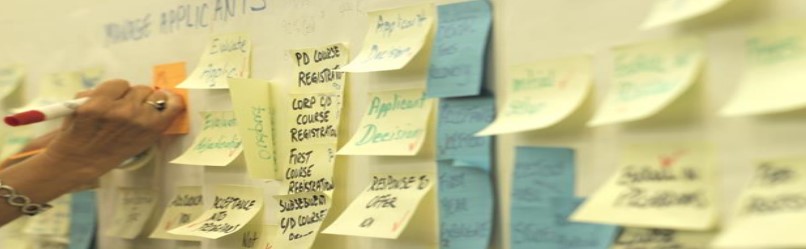
- Use a conference room that has a dry erase board as well as plenty of post it’s on hand. I like post its, because once we have the process, we can take a picture and move them around to help define the new process.
- Make sure that the details do not get erased or moved. Take a photo after every mapping meeting for redundancy.
- Make sure you have a note taker/ document gatherer.
- Have a current staff member that does the process present in the mapping exercise. Don’t leave anyone out, understanding the minutia of each process will be very valuable to help improve the process.
- Do NOT leave any step out, no matter how insignificant it may seem, this may result in something unforeseen later.
- list out the good, the bad and the ugly.
- Continuously ask “why” understanding is key. “Because we have always done it that way” or “that is how I was trained” is not a valid answer. Ask the tough questions. “Is there a reason we need this”, “what is the result we are looking for”
- Push for answers, this may be delicate, feelings can get hurt, people are worried about job security. Be gentle and reassuring that this process is to help them be successful, not to take their jobs. From experience, these same people are the ones that complain about how many hours they work. A good process improvement could give them some life/work balance back/
“Change is not an event, it’s a process”
Cheryl James
What you need to be successful
- Executive buy in.
- Department heads ready to embrace change.
- Staff that is ready for change.
- Have an open mind.
- Is there an easy answer.
- What is the industry standard / leading practice.
- Does this data exist, and where.
- Be ready for pushback.
- Expect criticism.
- Expect changes.
- Keep moving forward.
- Test, Test, Test, to ensure that with the new process you get expected results.

This will not be easy, but it will be worth it. I spent many hours working for different organization just wondering “why do we do this?” The answer is not always straight forward. The majority of people are scared of change, I am the opposite, I look for it. Change = Progress. The results and the gratification of a new and improved process can be awesome. The change does also not need to be huge like a new ERP, it just need someone with fresh eyes asking why. Take a chance, you’ll be glad you did.
Let’s start the conversation! What has or has not worked for you?
 Womanufacture & Hustle